

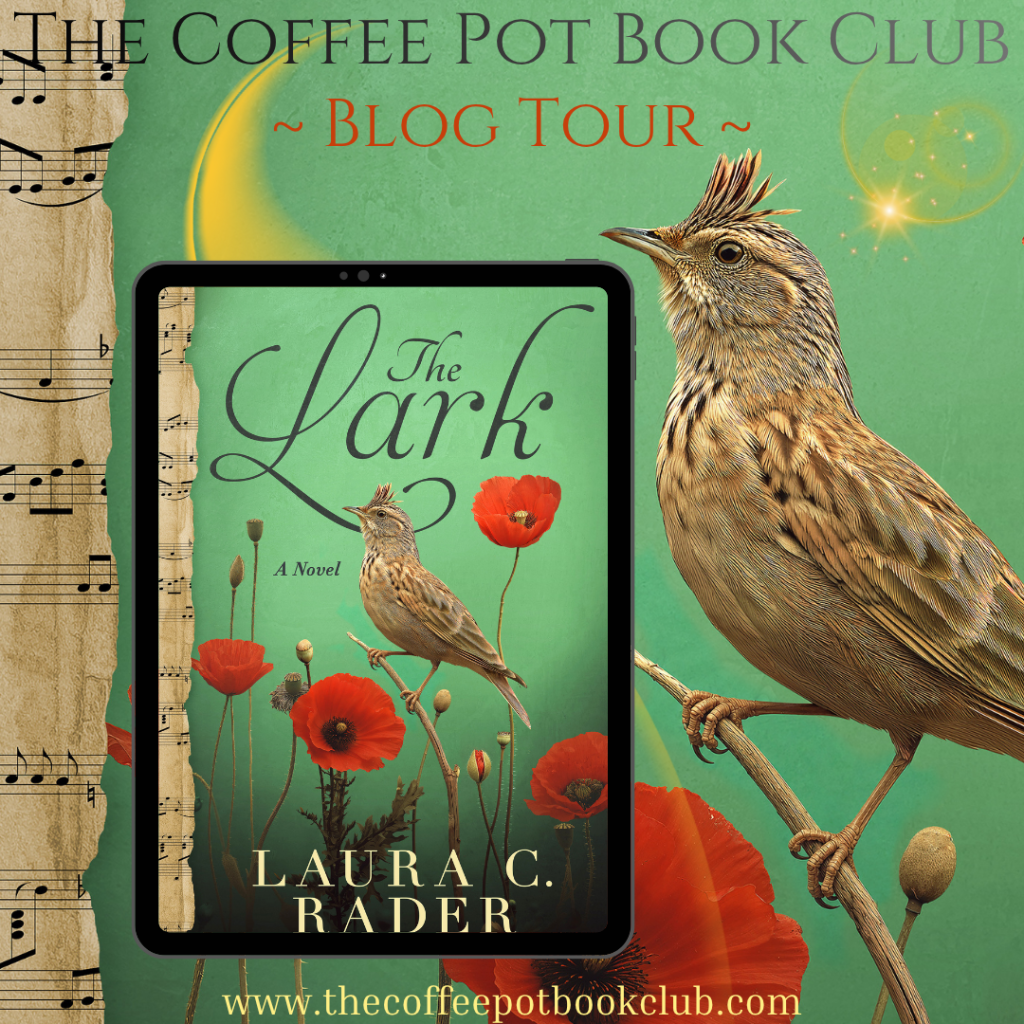
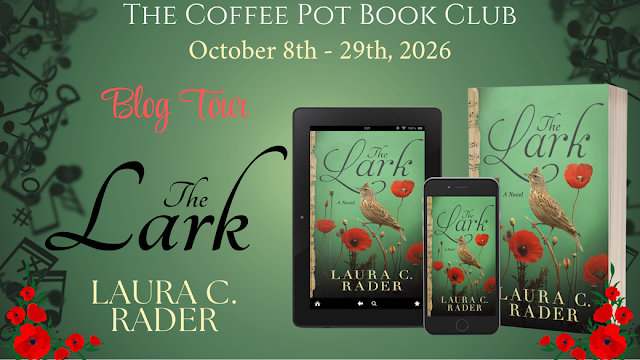
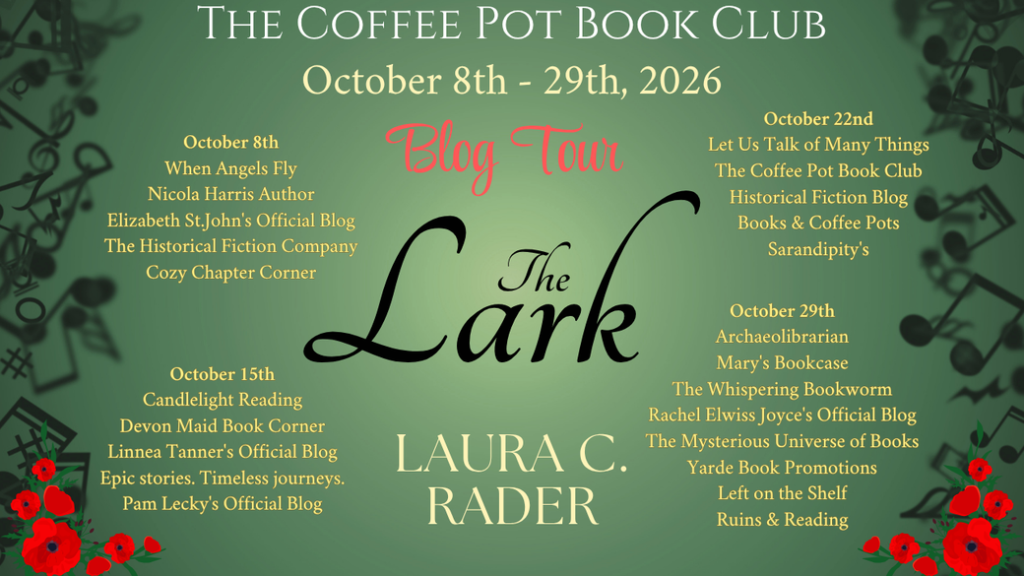
Today, I’m delighted to host The Lark by Laura C Rader. The book is on a blog tour with The Coffee Pot Book Club: https://thecoffeepotbookclub.blogspot.com/2026/09/blog-tour-the-lark-by-laura-c-rader.html
About the Book
When The Wizard of Oz graced the silver screen in 1939, it changed cinema and popular culture forever. But the true story began decades earlier with the young composer who risked everything to bring it to the Broadway stage.
At the turn of the century, twenty-three-year-old Paul Tietjens is a gifted classical pianist with dreams of greatness and a non-refundable ticket to Europe to study with the master composers of his time.
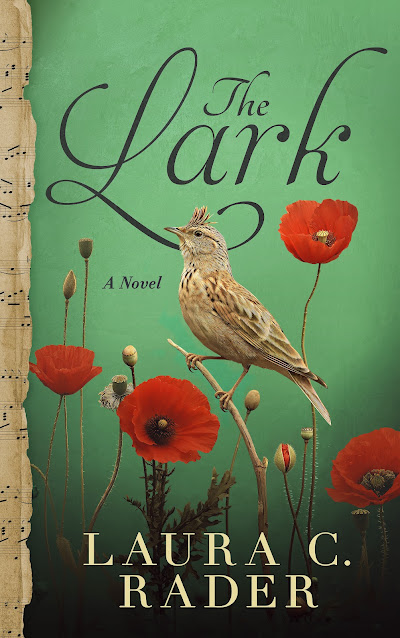
But when the bank calls in the debt on his family’s Missouri farm, Paul forgoes his dream to save them from financial ruin. Desperate to find a new road to success, he moves to up-and-coming Chicago, where he persuades author L. Frank Baum to collaborate on a comic opera of The Wonderful Wizard of Oz, setting the stage for the defining cultural touchstone that we know today.
Paul embarks on his opera with high hopes, but scandal threatens his soaring ambition when he falls in love with his best friend’s beautiful but married sister, and his fears grow as the Wizard of Oz demands not only his talent but his soul.
Inspired by Paul’s 1901 diary, The Lark follows Paul as he journeys from the theaters of Chicago to the streets of Manhattan, from his family’s Missouri farm to the beaches of Michigan, fighting to hang onto the chance of a lifetime, his integrity, and the woman he loves.
Buy Links
https://books2read.com/u/m0RDZV
The Book Details
Book Title: The Lark
Series: n/a
Author Name: Laura C. Rader
Publication Date: September 23rd, 2026
Publisher: Echoes Publishing
Pages: 425
Genre: Historical Fiction
Any triggers: No
Excerpt
Chapter Forty-One
Chicago’s Grand Opera House
June 16, 902
I ascended the grand staircase from the foyer to my seat in a private box. The theater boasted eight, divided into pairs, house left and right, draped with orange and blue curtains. I shared a box with Otto, Ollie, Louis, Baum, and Maud. Directly across the gallery from us, house right, sat Katherine, Mrs. Morgan, Daisy, Hugo, Ike, and Pauline. I’d glimpsed Den’s wife and her “escort,” Mazzanovich, in the foyer, but I saw no sign of Den himself. Baum said he was tied up in New York with business.
The house was packed, and a beautiful one it was. Now that our opera was a fait accompli, I had a chance to appreciate the venue. Sumptuous velveteen seats in bright crimson, soaring carved arches, and Burridge’s masterpiece, the main drop, a misty landscape painted in soft shades, harmonizing with all the rest. I gazed up above the proscenium arch at a bas-relief of Apollo and a dozen Muses, and prayed silently for their mercy.
“I hope they haven’t changed anything more since the dress rehearsal,” I said to Baum.
“If they did, don’t tell me. It’s going to be enough to see what they changed during the rehearsals.”
“Mitchell did keep all my instrumental music.”
“Doesn’t surprise me at all. You were born to compose beautiful orchestration. And I don’t blame you for not being able to write music for the slew of songs Mitchell threw into Act 3 at the eleventh hour.”
“Thank you.”
“Excited?”
“Apprehensive.”
The opening music swelled. I pictured the notes on the staff, silently anticipating the crescendos and rests and watching the conductor as I counted beats, mentally begging him to cue the different instruments at precisely the right moment.
The house lights dimmed, and the stage lights shone on Burridge’s lovely main drop as it rose, followed by the curtains. I settled back in my seat, took a deep breath, and let the extravaganza begin.
Act 1
My opening music is the only sound at first, the characters pantomiming in a golden autumnal Kansas farmyard. Upstage right sits a two-story farmhouse with faded paint, surrounded by a white post and rail fence, and a real horse carefully pulling a hay wagon strolls by. Farmhands work with hoes and pitchforks. Dorothy pets Imogene, her spotted cow, and in the first of many incongruous additions, a golfer in knickers and cap searches downstage, apparently for his missing golf ball.
The major-to-minor key shift signals the storm brewing. A few people on stage notice and peer up at the sky, and the volume of the music builds. A gauze curtain drops, and a magic lantern projects a swirling cyclone upon the farm, accompanied by a rumble of thunder from cymbals and kettledrums, shockingly unexpected. Everyone on stage runs for cover.
The music swells as the cyclone picks up the farmhouse, Dorothy, Imogene the cow, farm tools, and a golf ball and carries them into the sky.
Dorothy’s house sails through the air to some of my best music, haunting and beautiful, and written by the seat of my pants in April in New York to cover the long scene change.
About the Author

Laura C. Rader is the award-winning author of the biographical historical novel Hatfield 1677.
When she isn’t writing, you can find her conducting research, playing her 1905 antique piano, and spending time with her family, friends, and pets.
A native of Southern California, she now lives north of Raleigh, North Carolina.
Connect With Laura
Website • Twitter / X • Facebook • Instagram
Bluesky • Threads • TikTok • Pinterest
Amazon Author Page • BookBub • Goodreads
1 response to “The Lark”
-
Thanks so much for hosting Laura C. Rader today, sharing an extract from her compelling new novel, The Lark. We’re delighted you joined us.
Take care,
Cathie xx
The Coffee Pot Book Club

Leave a Reply